General Joomla! Module Configuration
All Joomla! modules share a number of configuration parameters. Head to Extensions >> Module Manager, look for RSContact and edit it. You will find, aside from the Custom RSContact! Parameters, the following tabs:
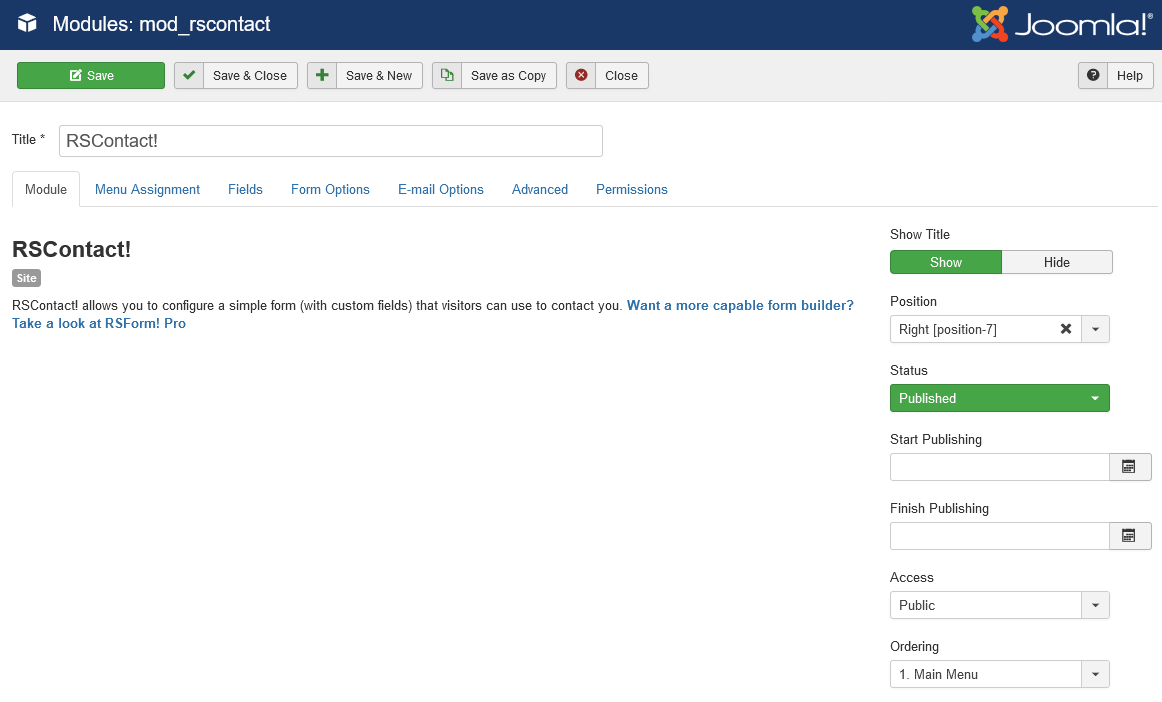
Module
- Show Title: Show / Hide - choose whether to show or hide the module's title
- Position: choose one of your frontend template's positions in which to display the module
- Status: Published / Unpublished
- Start Publishing: choose a date on which the module will get published - optional
- Finish Publishing: choose a date on which the module will get unpublished - optional
- Access: set an access level for the module. Your configured Joomla! Access Levels will be loaded here
- Ordering: set the module's ordering inside the chosen module position (other modules may be loaded on the same position)
- Language: assign a language for the module
- Note: add an internal note - optional
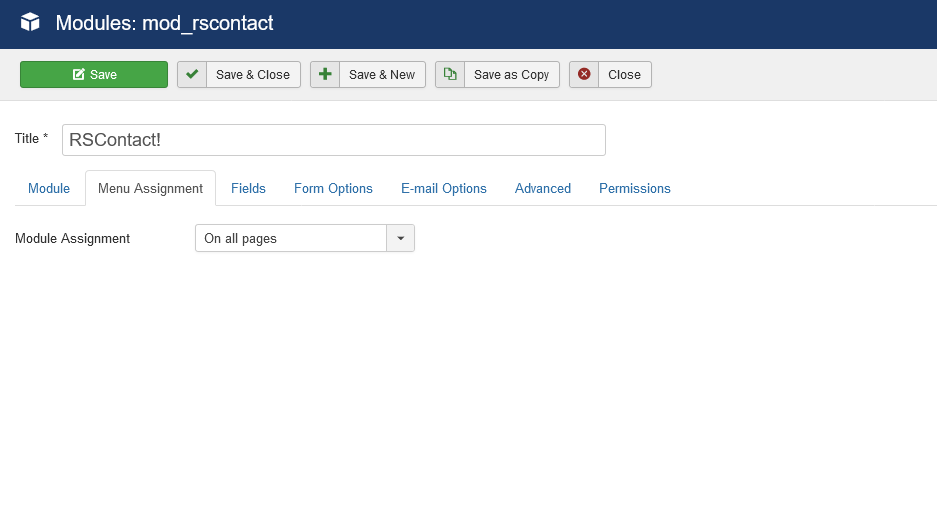
Menu Assignment
- Module Assignment: On all pages / No pages / Only on the pages selected / On all pages except those selected - choose which pages the module will get loaded on
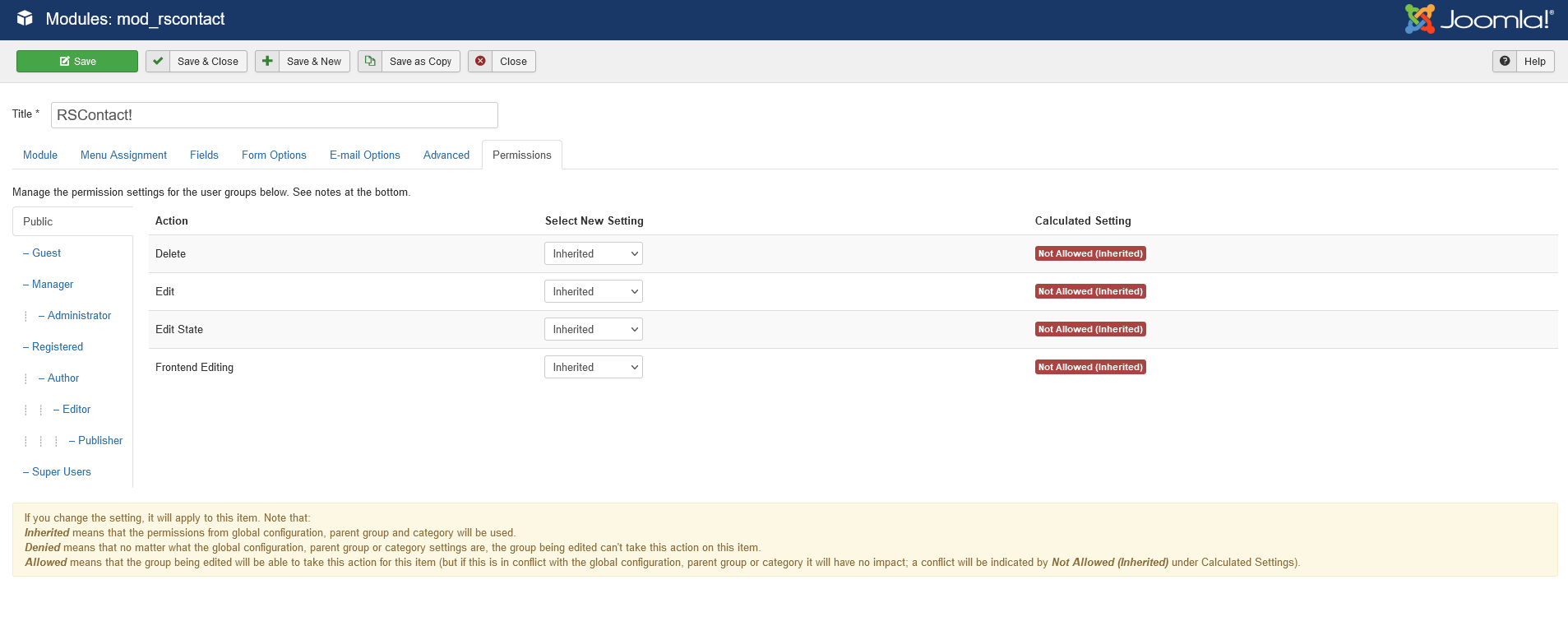
Module Permissions
The following settings can be configured for each of your Joomla! groups:
- Delete: Inherited / Allowed / Denied
- Edit: Inherited / Allowed / Denied - Allows / restricts users in this group to edit the module's parameters
- Edit State: Inherited / Allowed / Denied - Allows / restricts users in this group to alter the module's state - Published / Unpublished / Trashed
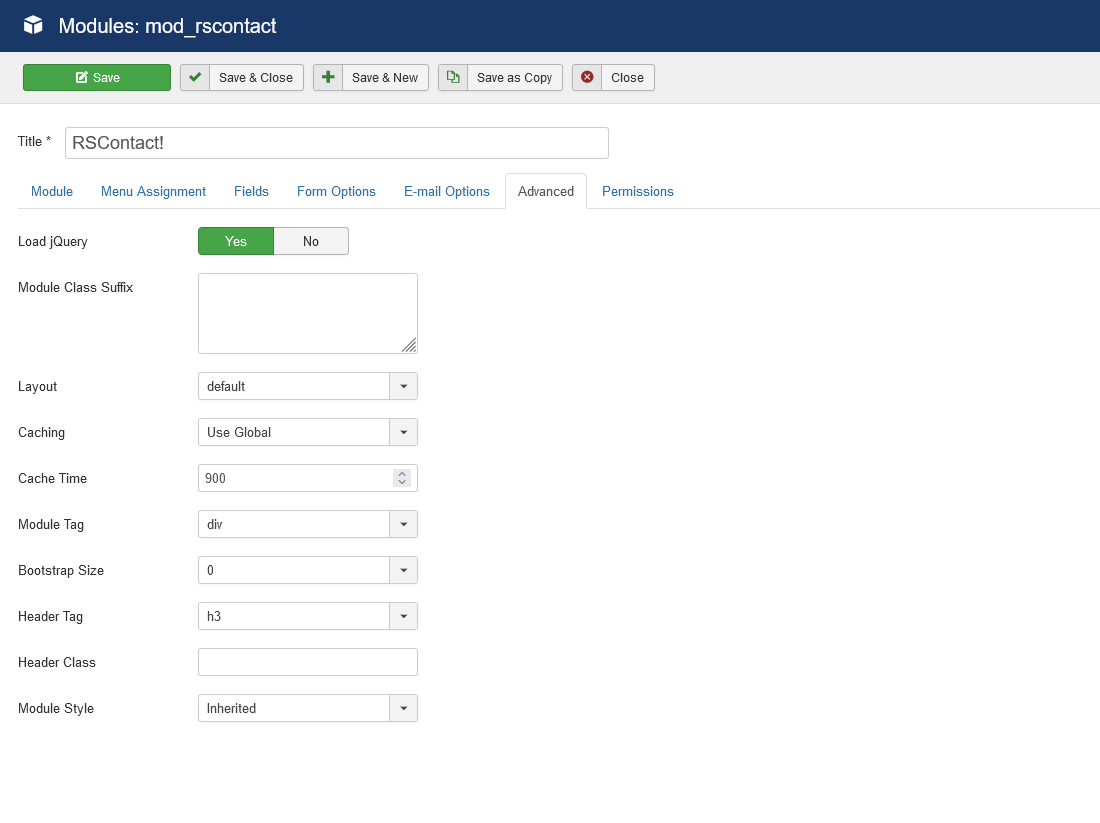
Advanced
- Load jQuery: Yes / No - Toggle loading of jQuery from the framework
- Module Class Suffix: - A suffix to be added to the CSS class of the module, useful for individual module styling
- Layout: - choose the layout of the module
- Caching: - Enable or use Joomla!'s global caching settings
- Cache Time: - set the caching time
- Module Tag: Choose an HTML container for the module
- Bootstrap Size: Specify how many Bootsrap grid spaces the module will use
- Header Tag: Choose an HTML container for the module's header
- Header Class: Specify an additional HTML class for the module's header - optional
- Module Style: Use this option to override the template's style that is normally associated with the module's current position
16 persons found this article helpful.
You Should Also Read
Custom RSContact! Parameters HOT |
Set field value via URL |
Emails are not getting sent |